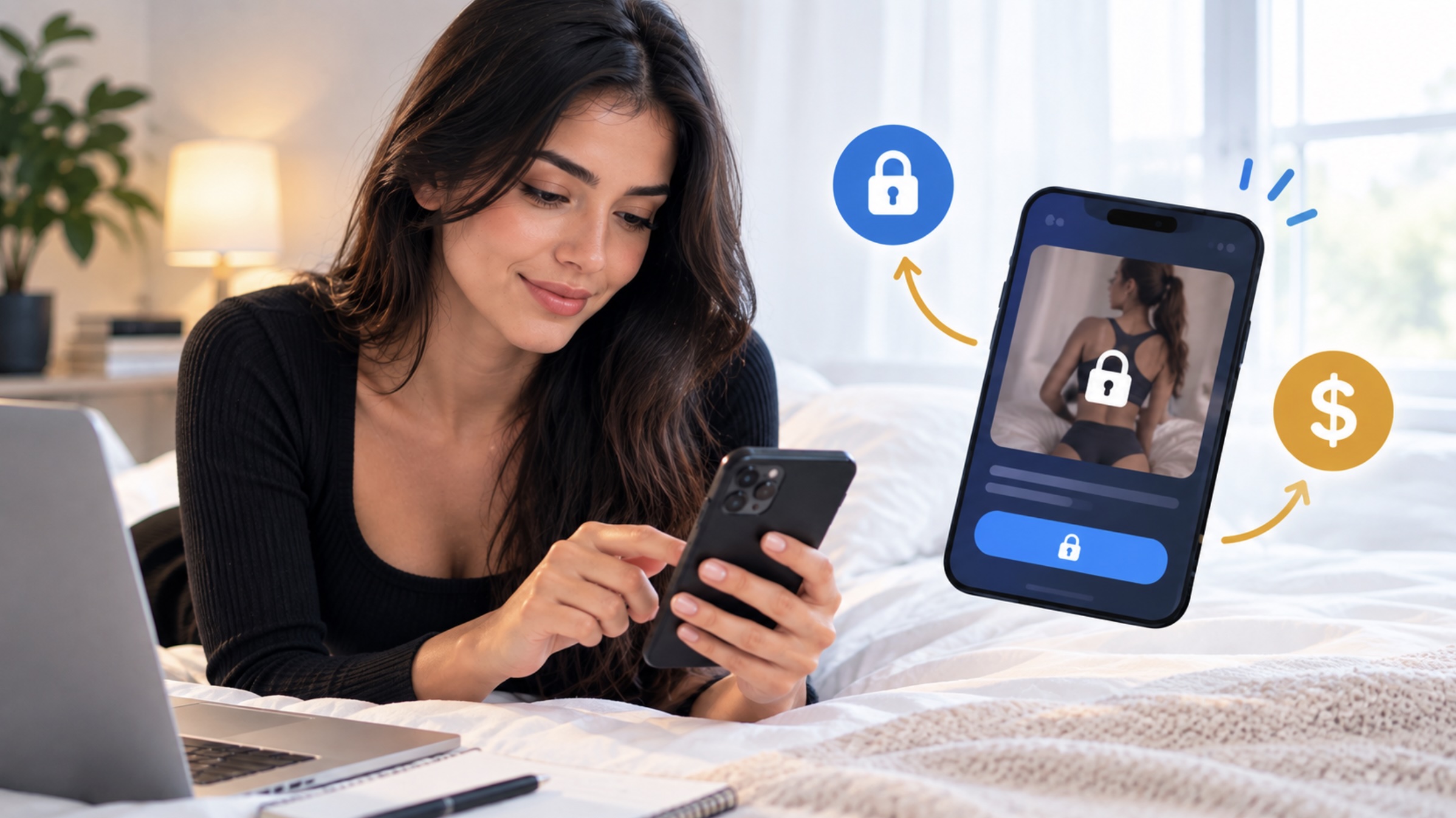
OnlyFans PPV, or pay-per-view, is a way to sell individual pieces of locked content to fans for a separate payment.
Instead of including everything inside the subscription, creators can offer additional content through paid messages or other locked offers.
For creators, PPV can create another revenue stream from the audience they have already built.
But there is an important difference between sending PPV and having an OnlyFans PPV strategy.
Anyone can lock a piece of content, choose a price and send it to their fans.
The harder part is knowing:
- What content should be offered
- Who should receive it
- What price makes sense
- When to send it
- How to follow up
- When to stop selling
- How to keep fans interested between offers
That last point matters more than many creators realize.
The goal isn't simply to get as many PPV unlocks as possible today.
The goal is to create a system where fans continue wanting to buy from you tomorrow, next week and next month.
Why Good PPV Strategy Is About More Than Price
A common mistake is treating PPV as a pricing problem.
A creator makes a video, chooses a number and sends it out.
If sales are weak, they lower the price.
If sales are strong, they may increase it.
But price is only one part of the equation.
The same content can perform differently depending on the fan receiving it, the timing of the offer, what happened in the conversation beforehand and how recently that fan received another paid offer.
Think about two fans.
One has just subscribed and has never purchased anything.
Another has been subscribed for months and regularly buys PPV and tips.
Sending both fans the exact same offer at the exact same price may not make sense.
Their behavior is different.
Their relationship with your account is different.
Their willingness to spend is different.
Your PPV strategy should reflect that.
What Should You Sell as PPV?
Before thinking about price or timing, decide what actually deserves to be a paid offer.
Not everything needs to be PPV.
If fans feel that every piece of content is locked, they may start feeling like they are constantly being asked to spend more.
Instead, PPV should give fans a reason to unlock something beyond what they normally receive.
Depending on your content strategy, PPV can include:
- Exclusive photo sets
- Longer or more detailed videos
- Content that isn't posted publicly on your feed
- Themed content
- Limited or special releases
- Bundled content
- Personalized or custom content
- Follow-up content connected to something a fan has already shown interest in
The important question isn't:
“What can I charge for?”
Ask:
“What would give this fan a reason to unlock?”
That small change in thinking can improve the way you plan your content.
Build a PPV Content Ladder
Instead of treating every PPV as a completely separate decision, create different levels of offers.
For example, you might have:
Entry-level content
A lower-priced offer that gives newer or less active fans an easy opportunity to make their first purchase.
Standard PPV
Your regular premium content at a price that fits your typical buyer.
Premium content
More exclusive or higher-value content reserved for fans who have demonstrated that they are willing to spend more.
Custom content
Personalized content where pricing is based on the specific request, time involved and the creator's established minimum.
The exact prices should depend on your audience, niche, content and previous sales.
There is no single PPV price that works for every creator.
The point of having levels is to stop treating every fan and every piece of content as if they have exactly the same value.
Price the Offer, Not Just the Content
When deciding what to charge for PPV, consider more than how long the video is or how many photos are included.
Think about:
- How exclusive the content is
- How much time it took to create
- Whether the fan has purchased similar content before
- How engaged the fan is
- Whether the offer is part of a larger sequence
- Whether the content is easily available elsewhere
- How much the fan has historically spent
This is where fan value becomes important.
A fan who regularly buys premium content may be comfortable with a higher-priced offer.
A brand-new subscriber may need a lower-friction first purchase.
That doesn't mean every fan should permanently receive a different price.
It means you should understand who is actually buying from you before making pricing decisions.
The $16,000 Custom: Why Timing and Context Matter
One of the most useful lessons from our agency's experience is that high-value sales are not always about starting with a high price.
We've seen a custom video sell for $16,000 to a fan who spent around $80,000 within a single year.
The important lesson isn't simply that a custom can sell for $16,000.
It is how the price became reasonable at that moment.
The fan had already demonstrated a very high willingness to spend.
There was an established purchasing history.
The creator and the team had enough context to understand that a premium offer could make sense for this particular buyer.
In other words, the $16,000 price wasn't pulled out of nowhere.
The offer made sense because of what had happened before it.
This is why PPV pricing shouldn't always be viewed as:
“What should I charge for this video?”
A better question is:
“What price does this offer make sense at, for this particular fan, right now?”
That is a much more useful way to think about premium sales.
Segment Your Fans Before Sending PPV
One of the easiest ways to improve your PPV strategy is to stop thinking of your subscriber list as one audience.
Your fans are not all at the same stage.
You may have:
New Subscribers
They have just joined and may still be deciding how much they want to spend.
For these fans, your first PPV offers should give them a clear reason to make that first purchase without immediately pushing them toward your most expensive content.
Regular Buyers
These fans have already demonstrated that they are comfortable spending.
They are often your core PPV audience.
Look at what they previously purchased and use that information to understand what types of offers interest them.
High Spenders
These fans deserve a different approach.
If someone consistently buys premium content, tips regularly or has already made significant purchases, sending them the same basic offer as everyone else may leave money on the table.
They may be more suitable for premium or personalized offers.
Inactive Fans
Not every inactive fan needs another sales message immediately.
Sometimes the better approach is to restart the conversation or give them a reason to engage before presenting another paid offer.
Segmentation doesn't have to be complicated.
Start by understanding who buys, what they buy and how frequently they spend.
Then use those patterns when planning your next PPV.
When Should You Send PPV?
Timing matters because even good content can be ignored if the offer arrives when your audience isn't paying attention.
There isn't one universal “best time” for every creator.
Your audience may live across different countries and time zones, and their activity patterns can be different from another creator's audience.
Instead of blindly following someone else's schedule, look at your own results.
Ask:
- When do my fans usually respond?
- When do my previous PPVs get the most attention?
- Which days generate the most purchases?
- Are my buyers mostly in one timezone?
- Does a particular type of content perform better at certain times?
Your goal is to identify patterns in your own audience.
If your fans are consistently active during certain evening hours, that may be a better opportunity for a PPV than sending it when most of them are offline.
Don't Send Every PPV as a Standalone Offer
A stronger PPV strategy often uses sequencing.
Instead of:
Create content → Send PPV → Move on
Think:
Build interest → Introduce the offer → Give fans time to respond → Follow up → Continue the relationship
For example, you might first discuss a topic or interest with a fan.
Then, if the conversation naturally leads toward relevant content, the PPV becomes part of that conversation rather than a completely random sales message.
This is especially useful for personalized offers.
The fan understands why the content is being offered to them.
That feels very different from receiving another generic sales message.
How Conversations Influence PPV Sales
PPV and chatting are connected, but they are not the same thing.
Our guide to OnlyFans Chatting Service covers how professional messaging teams operate behind the scenes. Here, the important point is how conversations can inform your PPV decisions.
A conversation can tell you:
- What type of content a fan is interested in
- Whether they are actively looking to buy
- What they have purchased before
- Whether they are interested in something specific
- Whether they are likely to respond to a premium offer
- Whether now is the right time to sell
That information can make a PPV offer more relevant.
Instead of asking:
“What PPV should I send today?”
You can start asking:
“Which fans have shown interest in something I can offer right now?”
That is a much more targeted approach.
Personalize the Offer When It Makes Sense
Personalization doesn't mean writing a completely different sales message for every subscriber.
It can be as simple as connecting the offer to something the fan has already shown interest in.
For example, if someone previously asked about a particular type of content and you later create something related to it, that fan is already more qualified for the offer than someone who has never shown interest.
The key is relevance.
A PPV should feel like an opportunity, not an interruption.
How Often Should You Send PPV?
This is where many creators go wrong.
They see that PPV can generate revenue, so they increase the number of paid messages.
More PPV sounds like more money.
But if fans start feeling that every interaction ends with another purchase request, the strategy can work against you.
The better question isn't:
“How many PPVs can I send?”
Ask:
“How often can I make a paid offer while keeping fans interested in hearing from me?”
Your answer will depend on your audience, content volume, buying behavior and how much free value you provide between paid offers.
Watch what happens when you increase your frequency.
If revenue increases while engagement remains healthy, you may have found a useful rhythm.
If purchases decline, fans stop responding or your audience becomes less engaged, you may be asking too often.
Avoid PPV Fatigue
PPV fatigue happens when fans start feeling overwhelmed by repeated paid offers.
The signs can include:
- Lower engagement
- Fewer unlocks
- More ignored messages
- Fans complaining about constant selling
- Lower response rates over time
- Fans becoming less interested in your messages
The solution isn't necessarily to stop PPV completely.
Instead, improve the balance.
Give fans reasons to engage with you that aren't always connected to a purchase.
Mix promotional messages with genuine conversation, free content, previews, updates and other forms of interaction.
Your fans should still feel like they are following a creator they enjoy, not subscribing to a constant sales funnel.
Follow Up Without Becoming Pushy
A PPV shouldn't necessarily be sent once and forgotten.
But following up doesn't mean repeatedly sending:
“Did you buy it?”
A better follow-up adds context.
For example, you might:
- Remind fans about the content after enough time has passed
- Mention that the offer is still available
- Follow up with fans who showed interest
- Connect the offer to a previous conversation
- Offer a related piece of content later
The timing matters.
A fan who opened the PPV but didn't purchase it has given you a different signal from a fan who never opened the message.
Likewise, a fan who asks a question about the content is showing more interest than someone who ignores the message completely.
Pay attention to those differences.
What to Do When a PPV Doesn't Sell
A weak PPV does not automatically mean the content was bad.
There are several possible reasons.
Maybe:
- The price was too high
- The price was too low to communicate the value
- The timing was poor
- The preview didn't create enough interest
- The offer went to the wrong audience
- Fans had received too many recent PPVs
- The content didn't match what that segment wanted
Don't immediately discount everything.
First, diagnose the problem.
If people opened the message but didn't buy, the offer or price may need examination.
If very few people opened it, timing, audience activity or the message itself may be the issue.
If your regular buyers purchased but less active fans didn't, the content may simply have been better suited to your stronger spending segment.
Use the result to improve the next offer rather than treating every PPV as a pass-or-fail event.
Test One Thing at a Time
You don't need to completely change your PPV strategy every week.
Instead, test individual variables.
For example:
Week 1: Test a different price.
Week 2: Test a different send time.
Week 3: Test a different preview or message angle.
Week 4: Test the offer with a different fan segment.
If you change everything at once, you won't know what actually caused the result.
Small tests can give you much better information about your audience.
Common OnlyFans PPV Mistakes
Sending the Same Offer to Everyone
Your subscribers have different interests and spending behavior.
Treating them as one audience limits your options.
Pricing Based Only on Content Length
A longer video isn't automatically worth more.
Exclusivity, relevance, demand and the fan receiving the offer can all affect perceived value.
Sending Too Many Paid Messages
More offers do not automatically mean more revenue.
If fans stop paying attention, future offers become harder to sell.
Constantly Discounting
If you lower your prices every time something underperforms, fans can learn to wait for discounts.
Diagnose the problem before changing the price.
Ignoring Previous Purchases
Your fans are giving you useful information every time they buy.
Use that history to understand what they actually want.
Giving Up After One Unsuccessful Send
A single PPV does not tell you everything.
Timing, audience, offer and pricing can all affect the result.
Look for patterns rather than making decisions from one send.
A Simple PPV Workflow You Can Start Using
If you're currently running your own account, you don't need a complicated system to get started.
Try this process:
Step 1: Choose the content.
Decide what makes the content worth unlocking.
Step 2: Identify the audience.
Ask which fans are most likely to be interested.
Step 3: Set the price.
Consider content value, fan history and the type of offer.
Step 4: Choose the timing.
Use your own audience activity and previous results.
Step 5: Send the offer.
Give fans a clear reason to unlock.
Step 6: Watch the response.
Track who engages, who buys and who doesn't.
Step 7: Follow up intelligently.
Don't repeatedly push the same message. Use the response to decide what happens next.
Step 8: Record the result.
Keep track of what worked so your next PPV isn't another guess.
That last step is important.
Your PPV strategy should become smarter over time.
When Does PPV Become a Full-Time Job?
At the beginning, managing PPV yourself can be relatively simple.
You create the content, choose the price, send the message and check the results.
But as your account grows, the work around PPV grows too.
You may need to:
- Plan multiple offers
- Segment fans
- Track purchasing behavior
- Monitor pricing
- Schedule sends
- Follow up
- Respond to conversations
- Handle custom requests
- Analyze revenue
- Create new content
- Manage other platforms
Eventually, PPV stops being a single task.
It becomes an ongoing sales system.
That's often the point where creators start looking at professional support.
Where Professional OnlyFans Management Fits In
A professional management team can take the PPV strategy beyond simply sending locked messages.
The bigger advantage is having the different parts of the account work together.
Conversations can reveal what fans are interested in.
Fan purchasing history can influence segmentation.
Content planning can support future PPV offers.
Pricing can be adjusted based on actual buying behavior.
Follow-ups can happen consistently.
And results can be reviewed to understand what is working.
This is especially useful when the creator no longer has enough time to personally manage every part of the sales process.
For a deeper look at what professional management can include, see our guide to OnlyFans Management: What It Includes and How It Works.
The goal isn't to hand over the relationship with your fans.
It's to build a system that lets the account keep growing without the creator having to personally manage every message, offer and follow-up.
When Should You Consider Professional Help?
You may be ready for professional support when:
- PPV takes hours of your day
- You struggle to follow up consistently
- You have a growing subscriber base
- You aren't sure how to segment your fans
- Your pricing is mostly guesswork
- You are sending offers without tracking the results
- You are constantly creating content but don't have time to monetize it properly
- You want to grow but can't keep up with the workload
At that point, the problem may no longer be whether you know how PPV works.
The problem may be having enough time and systems to do it consistently.
Ready to Take Your PPV Strategy Further?
If PPV is becoming a major part of your account but managing pricing, fan segments, follow-ups and sales opportunities is taking over your time, professional support may be worth considering.
Apply for a Free Growth Strategy Call →
Eros Agency's application process includes a growth audit and strategy session designed to identify opportunities around traffic, conversions, upselling and account growth.
Frequently Asked Questions About OnlyFans PPV
What does PPV mean on OnlyFans?
PPV stands for pay-per-view. It allows creators to charge fans separately to unlock specific premium content rather than including that content within the regular subscription.
How much should I charge for OnlyFans PPV?
There is no universal PPV price that works for every creator. Consider the content's exclusivity, your audience, previous purchase behavior, fan engagement and the type of offer before setting a price.
How often should I send PPV on OnlyFans?
There is no fixed number that works for every account. Monitor your unlocks, revenue, engagement and signs of fan fatigue to determine how frequently your audience responds well to paid offers.
How do I avoid annoying fans with PPV?
Avoid making every interaction a sales pitch. Balance PPV with free content, genuine conversation, previews and other forms of engagement. Segment your audience so you're not sending every offer to every fan.
Should every OnlyFans subscriber receive the same PPV?
Not necessarily. Fans have different interests, spending habits and levels of engagement. Segmenting your audience can help you make more relevant offers.
What should I do if my PPV isn't selling?
Don't immediately lower the price. Look at the entire offer, including the audience, timing, preview, content, pricing and recent PPV frequency. Use the results to determine what should change next.
Can I sell custom content through PPV?
Custom content can be sold separately from regular PPV, with pricing based on the specific request, time involved and your established minimum. High-value custom sales can also develop from a fan's previous purchasing behavior and demonstrated willingness to spend.
Is PPV part of OnlyFans management?
Yes. PPV can be one part of a broader OnlyFans management strategy that also includes fan communication, marketing, content planning, analytics, pricing and account growth.
When should I consider hiring an OnlyFans management agency?
Professional support may make sense when PPV, fan messaging, content planning, marketing and follow-ups are taking significant time away from content creation or when you need a more organized system to scale the account.
Final Thoughts
OnlyFans PPV works best when it is treated as a strategy rather than a button you press whenever you have new content.
The strongest approach starts with the content itself, then considers the right fan, the right price, the right timing and the right follow-up.
Most importantly, don't measure success only by how much you sell today.
A good PPV strategy should help you generate revenue without teaching your fans to ignore you.
Give people reasons to engage.
Understand what they buy.
Pay attention to timing.
Personalize offers when it makes sense.
Follow up without becoming repetitive.
And keep testing what works for your specific audience.
Because the goal isn't simply to sell more PPV.
It's to sell more while giving fans a reason to keep coming back.
Ready to grow
with Eros?
Apply for a free growth strategy call and see how our team can help scale your brand, revenue, and free time.
